Birkly
Birkly is an open-source CMS rethought from the ground up — built to stay free of heavy dependencies, package managers, and inherited stacks. Flat files, a straight PHP core, proven technology you can read and own. That sounds quieter than most CMS pitches; in practice it keeps the system clean, manageable, and robust, and leaves room for your own front-end, for humans, and for AI.
Founder, Head of Product & Design
2025 – today

HQ: Højer, DK
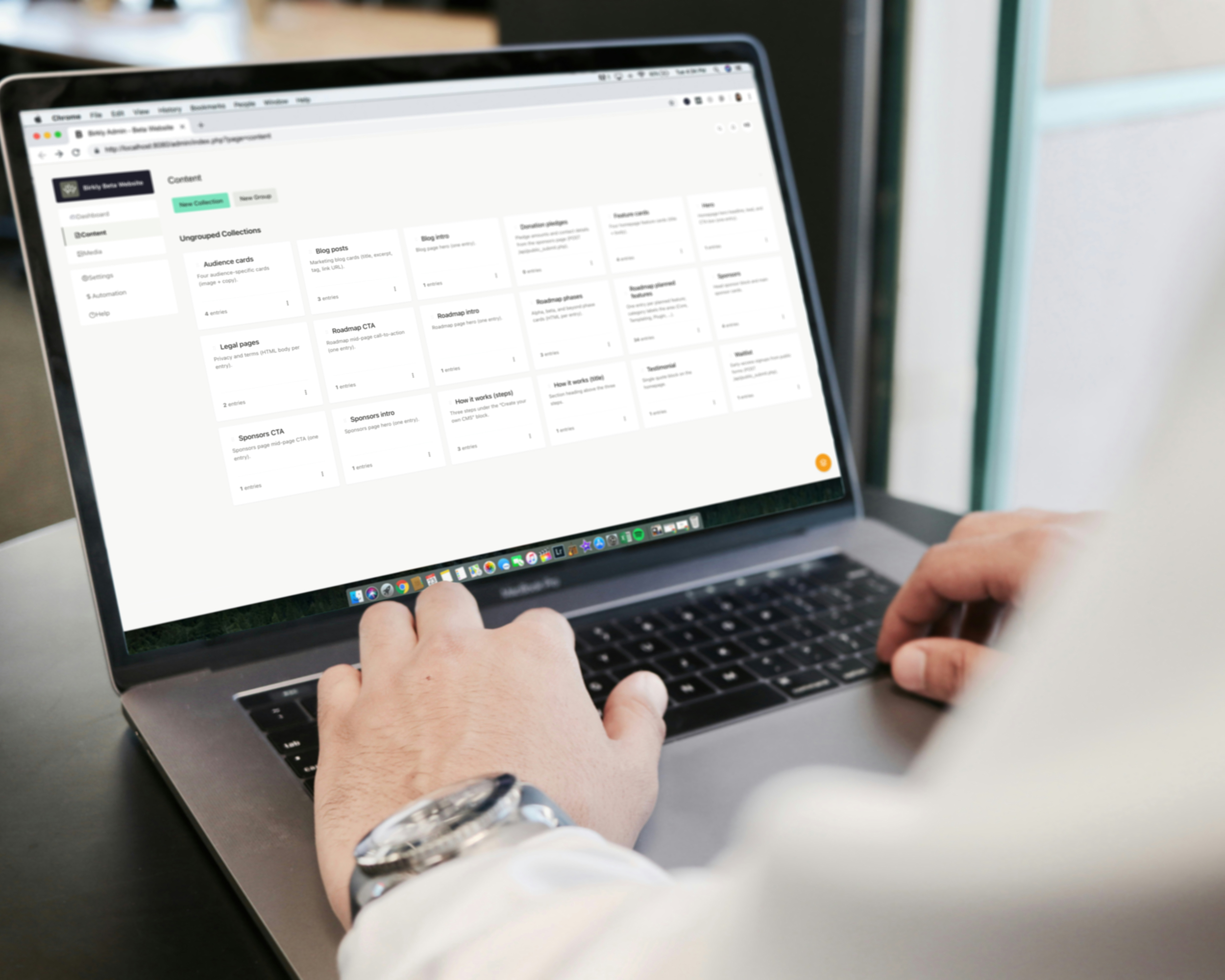
I took care of every aspect of Birkly — product, design, engineering direction, business setup, branding, and marketing.
Birkly started with frustration: a simple site should not need a fragile machine around it. Dependency graphs, build pipelines, and stacks that keep growing “because everyone else does” were the opposite of what I wanted to run. I aimed for something that works on normal hosting, keeps dependencies under control, and gets stronger through extensions you actually choose.
What came out of that: flat files you can copy and own, templates you can read, APIs when you need a different front-end, and AI hooked up with your provider and your rules — approvals first, not a gimmick on the landing page.
My main areas of work:
 Product Design
Product Discovery
Product Management
Product Strategy
Web Design
Branding
Design System
Administration
Simple architecture on purpose — built for today.

The core idea is simply simple. Birkly did not take shortcuts in development — no hiding complexity behind endless packages, libraries, or package-manager layers — so the vision can become reality: fair, open technology that is clever enough for humans and clear enough for AI. A dependency-light core stays secure and extensible; power comes from plugins, templates, and field types you choose. Developers and AI work against something readable, not a maze — and you are not locked into our front-end when you already have a stack you like.

The AI user
Your provider, explicit roles, approvals before anything ships.
Built from scratch
No inherited stack — proven core, extensions you opt into.
Plain-English templates
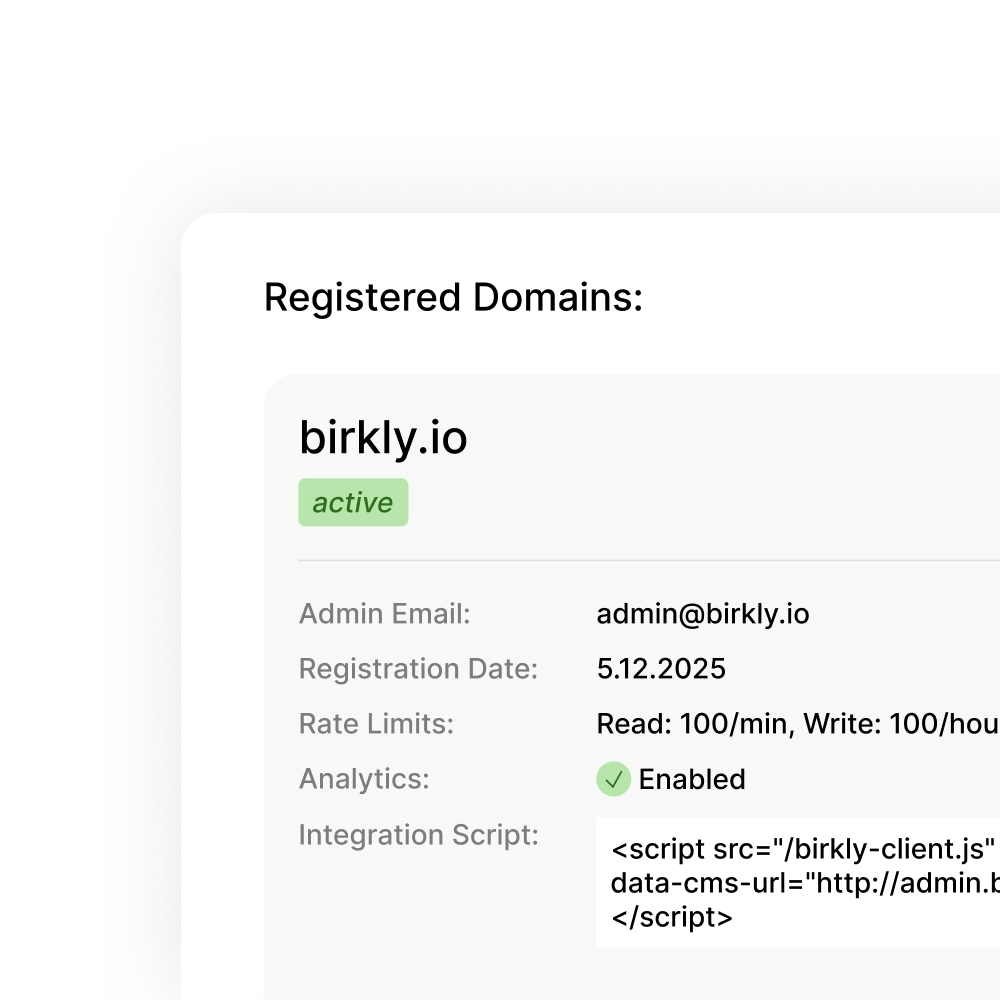
One script + whitelist to hook up a project; optional API if you want your own stack.
Plugins & field types
Sub-entries, public submissions, real extension hooks.
UI / UX
Information architecture, design system, interaction patterns for daily publishing.
The result
Fair open tech — and where the project is headed.
The Challenge
A lot of CMS stacks look fine until you operate them: dependencies, build steps, and hosting assumptions pile up, and the “simple” site is no longer simple to run or hand off. For small teams and client work, that friction shows up as risk — upgrades, security noise, and “it worked yesterday.”
AI makes that worse if it is only marketing: a button with no real roles, no trail, no gate before a change goes live. I wanted structured content, real permissions, and workflows first — then AI wired in so it can actually be trusted.
So the challenge was to build something with flat-file ownership, an admin people can use without a manual, public submissions you can moderate, and extensions that add power without turning the core into a junk drawer.
The Solution
Birkly keeps the core dependency-light. Content lives in files with a clear layout — backup, restore, and deploy stay understandable, and you are not locked into a SaaS export story you do not control.
On top of that: plugins, field types, templates, optional modules — you turn on what you need instead of inheriting a whole platform by default.
For AI: you bring your own provider; each connection is scoped like a user; nothing sensitive executes without going through the approval queue. That is the point — useful help, still your rules.
The artificial intelligence user

Birkly treats connected AI like any other actor in the system: it is a user with roles and permissions, not a magic backdoor. You bring your own provider (OpenAI, Anthropic, Google, …) — you pay your bill, you pick the vendor, and the CMS stays neutral.
Its capabilities are only what you assign. It does not get to bypass that because it is an API.
The architecture stays deliberately simple — structured content, collections, and APIs are easy to point at. That is what “simple enough for AI” means here: fewer mistakes, less guessing, outputs that map to real fields and entries. Clever where you need roles and approvals; straightforward where the model just needs to read the system. Admin chat and MCP hooks follow the same rule: help where it helps, humans before anything ships.
- Bring your own AI provider (vendor-neutral)
- AI connections are role-scoped “users”
- Approval queue before execution (auditability)
- Admin chat + external tool connections via MCP
From the ground up — without the stack

Birkly is rethought without the usual shortcut: stacking package managers, frameworks, and libraries until nobody knows what the project actually depends on. Instead: flat files, a straight PHP core, readable templates — proven technology that can look “old-school” on paper until you operate it against today’s problems; then the trade-off makes sense. The system stays clean, manageable, extensible, secure, and robust because the foundation stays small. Dependency-free, or as close as we can honestly get, is a pillar — fewer holes from other people’s packages, less maintenance theatre, less setup pain. Anything extra is opt-in, not inherited.
- Flat-file content for ownership and portability
- Works on common hosting setups
- Template-driven sites or headless API consumption
- Predictable core with safe defaults
Templates: plain English, real routing
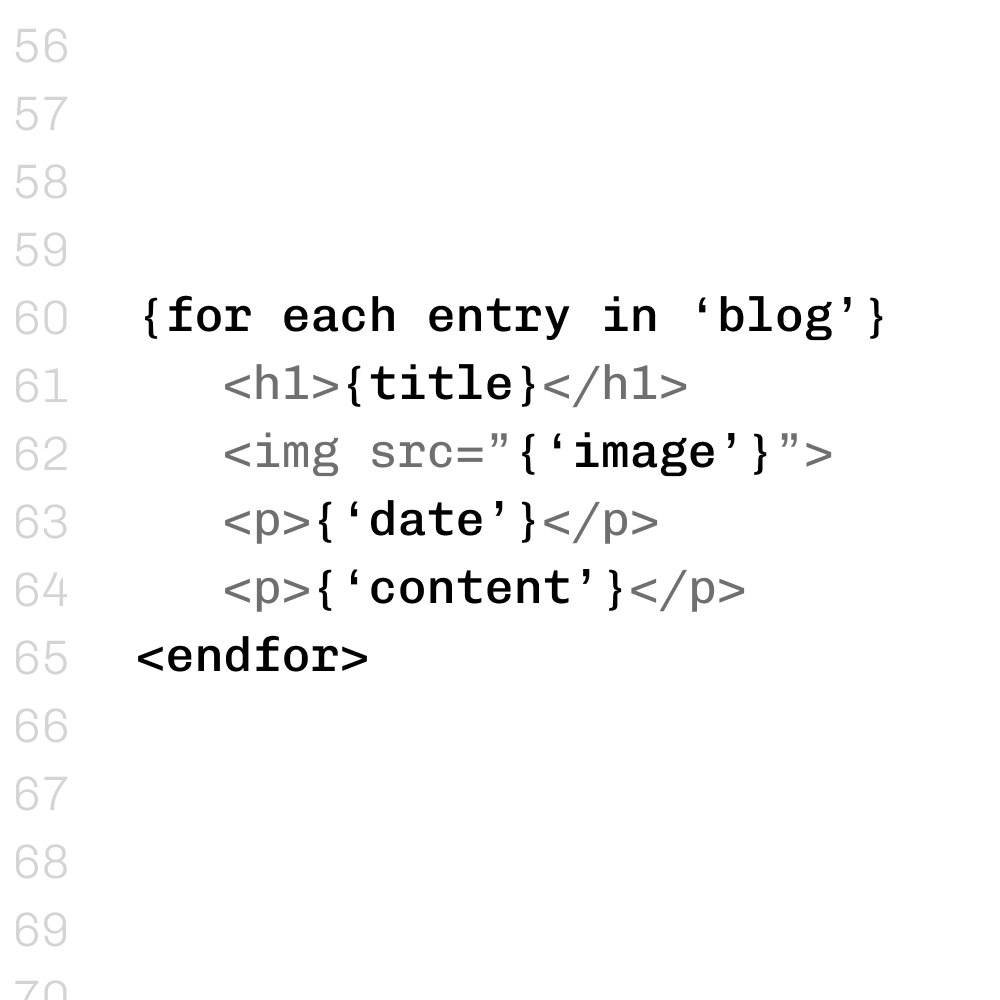
The templating engine is a little different on purpose: you wire a project in securely with one script and whitelisting — no mystery handshake. The language reads almost like plain English, so you are not locked to pure developers only; founders, business owners, designers, and marketers can change what they need without pretending to be ops. Example: a post.html can drive all blog posts and route URLs automatically. Templates pull data from the CMS and push work back without ceremony. And if you already have a front-end or stack you like, you can skip our rendering layer and use the API only — no cage, no forced toolchain.
- Readable template syntax with clear conventions
- Loops, filters, conditionals, and nested retrieval
- Admin UI templating with helpers and JSON injection
- Template-first sites without a JS build chain
Plugins, field types, real features
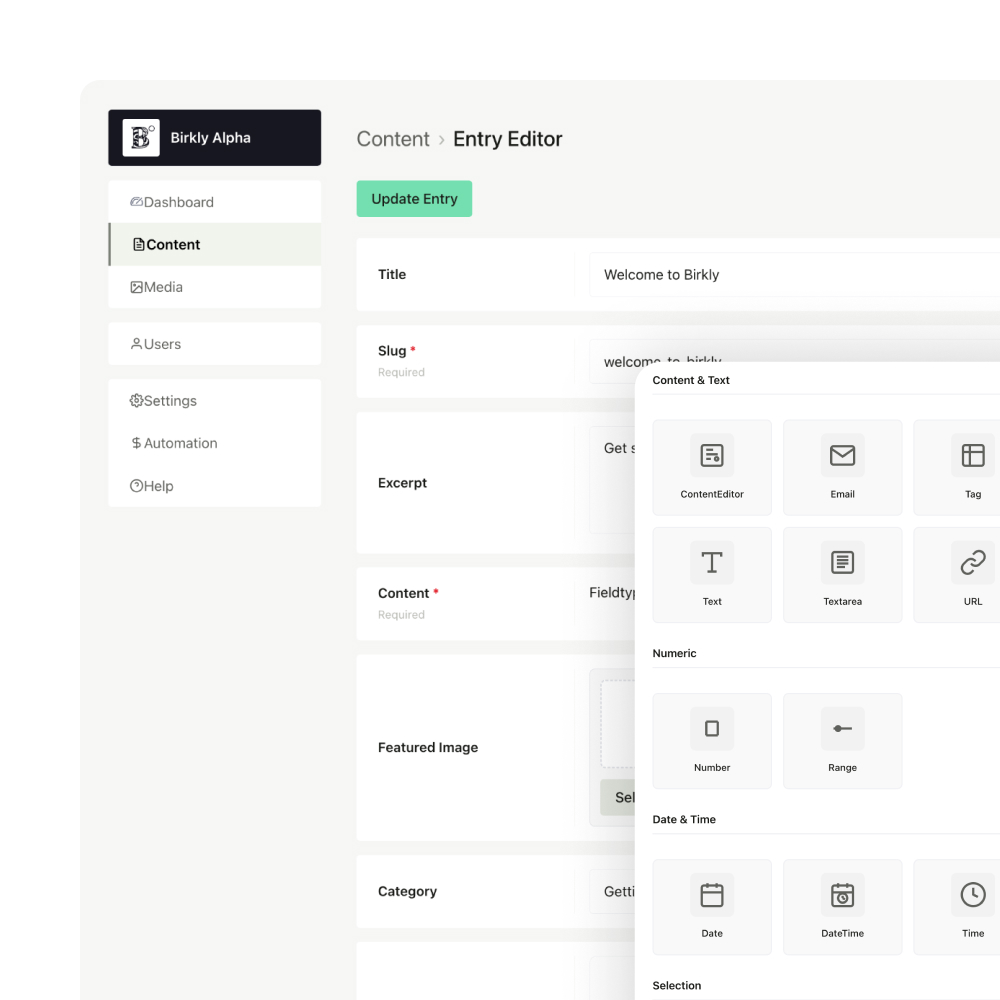
Extensions are how the product grows without bloating the core: plugins carry metadata and settings schemas, field types can be auto-discovered (PHP, plus JS/CSS when needed), sub-entries handle hierarchy, and public submissions get rate limits and moderation so the front door does not become a spam hose. The point is the same as everywhere else in Birkly — add capability in modules you can see and remove, not hide it inside “the platform.”
- Plugins with metadata + settings schemas
- Auto-discovered field types (PHP + optional JS/CSS)
- Sub-entries system for hierarchical relationships
- Governed public submissions (rate limits, moderation)
The admin — designed as a product, not an afterthought
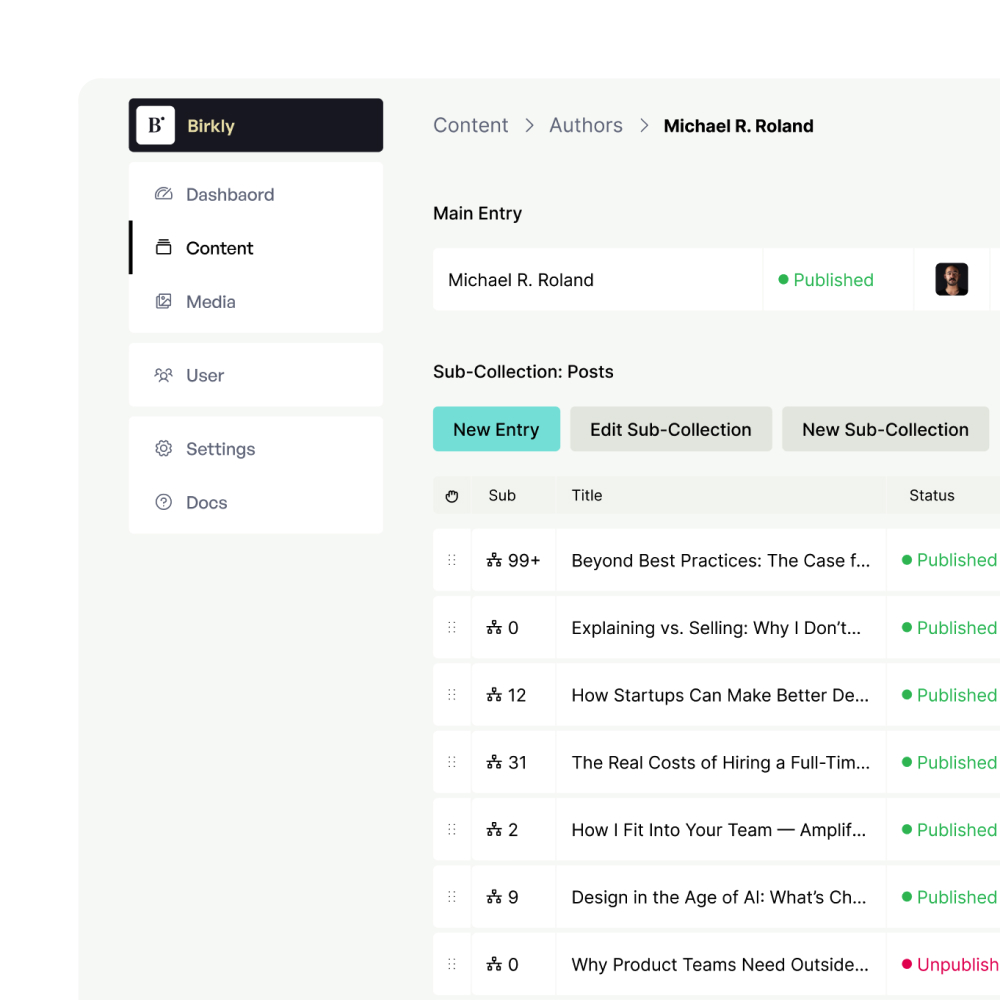
As founder and designer, the admin is where most of the product work had to land. I started with information architecture — how collections, entries, settings, and permissions connect, and what someone should see on day one versus month three. From there: layout, typography, spacing, and a small design system so the interface stays calm and consistent. Not a theme slapped onto features; an admin that feels designed for people who publish, moderate, and configure things every week.
The harder flows got the same treatment: approvals, AI connections, moderation, nested content — the places CMS panels usually turn into icon soup. Clear states, readable permissions, shared patterns between lists, editors, and settings so you are not re-learning Birkly on every screen. Field layouts and editor chrome are tuned for long sessions, not demo screenshots. Less noise than most backends; more room for the actual work.
- Information architecture across collections, entries, settings, and permissions
- Design system — typography, spacing, components reused throughout the admin
- Shared interaction patterns for lists, editors, and configuration
- Complex flows (approvals, AI, moderation) designed for clarity, not power-user hacks
- Editor and field layouts built for daily publishing, not one-off demos
The result — and where this goes
Put together, Birkly is a CMS you can own: files on disk, a core you can still read, extensions you can add or remove, AI that behaves like any other user — with approvals before anything goes live. Developers keep their stack; the API stays yours. The foundation stays manageable and secure because it was kept simple on purpose, not because we promised it in a deck.
Longer term, I see Birkly as a European-based project at the intersection of AI and digital infrastructure — open source, fair technology, not another walled garden. The ambition is to change how we build web projects: less toolchain theatre, more structure that teams, tools, and models can actually work with. Clever where humans need judgment; simple enough where AI needs clear fields, permissions, and trails. No shortcuts in how it was built, so the end product vision has a chance to become real — not another CMS that only looks good in screenshots.
What comes next is shipping, polish, and real-world proof. If you are wrestling with the same questions — product shape, CMS architecture, AI that has to behave — I am always up for that conversation.